Aggregate driveway cost in New Zealand runs anywhere from about $25/m² to $250/m², because "aggregate driveway" describes two completely different products with a price gap of roughly five to one. Loose aggregate, meaning metal chip or gravel spread over a compacted base, sits at about $25–$50/m² where the base is already sound, and considerably more where that base has to be built from scratch. Exposed and coloured aggregate concrete, the speckled stone finish on a poured slab, sits in the decorative band at roughly $150–$250/m². Every figure on this page is GST-inclusive consumer pricing unless stated otherwise, and all of them are indicative ranges that a site visit confirms.
What people mean by "aggregate driveway" (there are two answers)
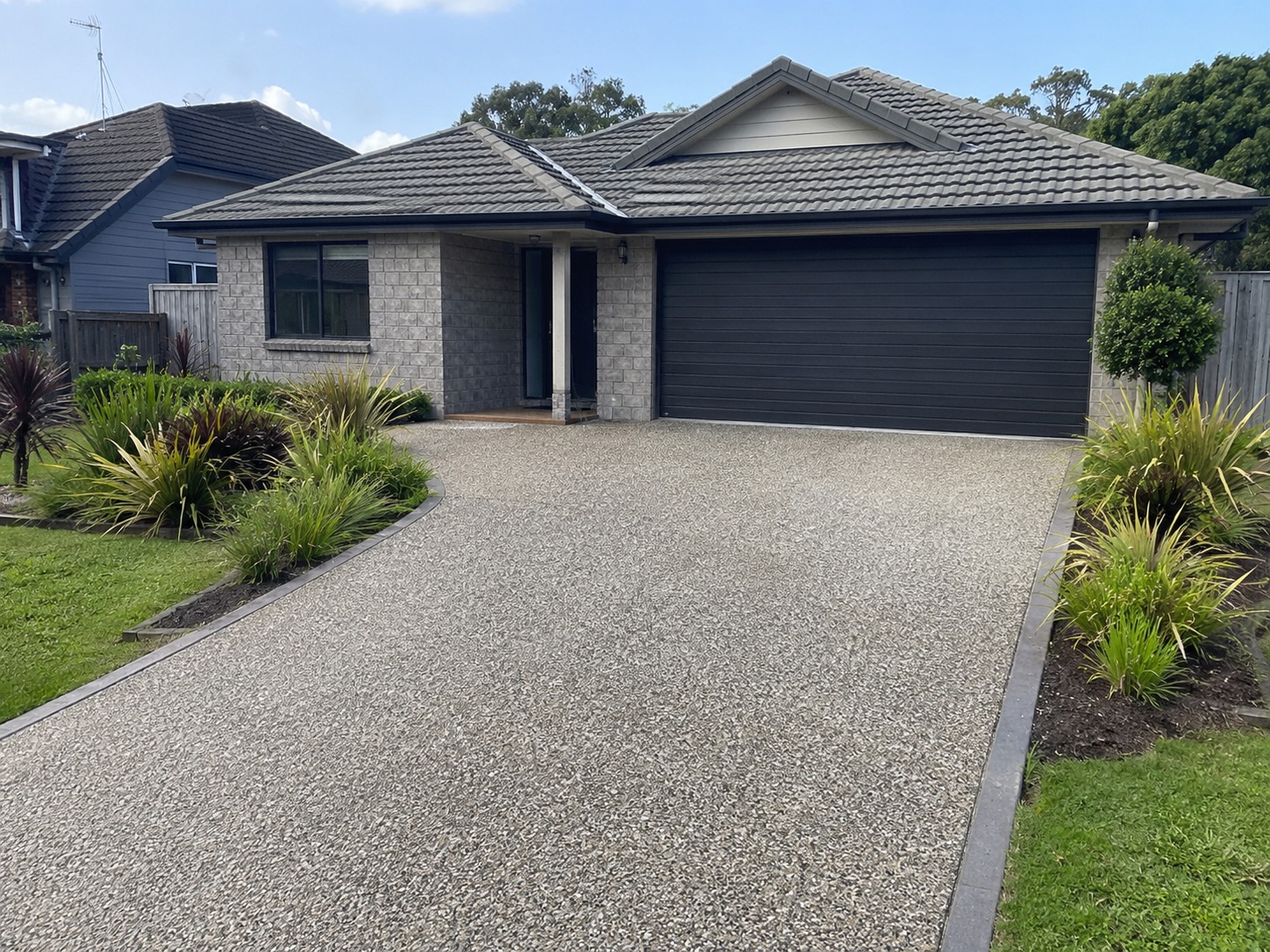
Loose aggregate is stone sitting on the ground. Metal chip, gravel or a chip seal laid over a compacted basecourse. It is permeable, so rain soaks through rather than running off, and it is the cheapest surface you can put down. It is not repaired in the way a slab is repaired. It is topped up, raked and eventually re-laid.
Exposed aggregate concrete is a structural driveway with a decorative face. A normal slab is poured, then the surface is washed back before it fully hardens so the stone in the mix shows through. Coloured aggregate is a variant of the same thing, with oxide through the mix or a selected stone blend doing the work, rather than a third separate category.
That distinction matters because the two sit at opposite ends of the price scale. A homeowner pricing "an aggregate driveway" can be quoted $2,000 or $10,000 for the same 40 m² and both quotes can be honest. The rest of this article puts them side by side so you can see which one you are actually buying.
Aggregate driveway cost compared
| Surface | Indicative cost per m² | Expected service life | Maintenance you will actually do | Best suited to | Main drawback |
|---|---|---|---|---|---|
| Loose aggregate / metal chip | $25–$50 spread over a sound existing base. Materially higher where basecourse, edging and drainage are needed. One NZ cost estimator puts a fully built-up gravel drive at around $140/m² | No fixed life. Topped up every few years, re-laid periodically | Rake, top up, spray weeds, fill the low spots | Long, flat, well-drained drives. Lifestyle blocks. Sites where a permeable surface helps with stormwater | Migrates on any slope, washes out in heavy rain, potholes and weeds, tracks into the garage |
| Chip seal | One bracket above loose chip. Usually priced by the job rather than the m² on short drives | Resealed on a cycle rather than replaced | Reseal when the chip starts to ravel, patch the edges | Long rural-edge drives where the plant can be brought in economically | Edges ravel without a kerb, uneconomic on a short urban drive, poor on tight turning circles |
| Plain concrete, broom finish | $90–$160 in Auckland | Decades when built to spec, see the note on service life below | Wash down, reseal occasionally, keep an eye on the control joints | Most Auckland urban drives, steep sections, heavy vehicles, small awkward sites | Plain appearance, and concrete can crack |
| Exposed aggregate concrete | $150–$250 typical decorative band | Same structural life as plain concrete | Reseal roughly every 5–10 years | Kerb appeal plus grip, particularly on sloped drives | Costs more than plain, and the sealing cycle is real work |
| Coloured aggregate concrete | Same $150–$250 decorative band. One NZ estimator notes that special aggregate blends can add 10–30% | Same structural life as plain concrete | Reseal, and expect the colour to weather | Matching a house palette or a landscaping scheme | Colour varies between batches and over time |
Where these numbers come from. The concrete ranges are from a September 2026 New Zealand market pricing survey. The loose chip, asphalt and reseal figures are from published NZ driveway cost estimators. The construction specifications quoted later come from the New Zealand Master Concrete Placers Association *Code of Practice for Concrete Placement of Domestic Driveways*. Consumer figures like these are normally GST-inclusive, while trade quotes are often plus GST, so ask which basis any quote uses before you compare it to anything. Treat all of it as indicative until a contractor has stood on your site.
If exposed aggregate is the one you have settled on, the full exposed aggregate price breakdown goes further into stone choice, wash depth and sealing than this comparison does.
Why the published prices disagree so much
Search for gravel driveway pricing and you will find $25/m² on one NZ estimator and around $140/m² on another. Neither is wrong. They are pricing different jobs.
The low figure prices stone spread over a base that already exists. The high figure prices a whole driveway: excavation, spoil carted away, compacted basecourse, edging and drainage. Same product on the surface, entirely different scope underneath. Concrete works the same way. A base concrete rate usually excludes earthworks and decorative finishes, so multiplying a per-m² rate by your area gives you a floor, not a total.
The second reason is the GST basis. Trade sources commonly quote plus GST and consumer guides usually quote GST-inclusive. On a $12,000 driveway that is a difference of roughly $1,800, which is enough to make a dearer quote look cheaper.
Three questions sort out most of the confusion:
- Is this figure plus GST or including GST?
- Does it include excavation, spoil removal and basecourse, or is that a separate line?
- What slab thickness in mm and what steel mesh is priced?
What an aggregate driveway costs for a real Auckland drive
Rates only get you so far. Here is what the table above works out to on two common Auckland jobs, GST-inclusive.
A single urban drive, roughly 40 m², the sort of frontage you get in Mount Eden or Papatoetoe:
| Surface | Indicative total |
|---|---|
| Loose chip over a sound base | $1,000–$2,000 |
| Plain broom-finish concrete | $3,600–$6,400 |
| Exposed or coloured aggregate | $6,000–$10,000 |
A longer drive, roughly 120 m², a rear site or a Rodney lifestyle-block approach:
| Surface | Indicative total |
|---|---|
| Loose chip over a sound base | $3,000–$6,000 |
| Plain broom-finish concrete | $10,800–$19,200 |
| Exposed or coloured aggregate | $18,000–$30,000 |
At 40 m² the saving on loose chip is a few thousand dollars and you carry the upkeep forever. At 120 m² the gap runs into tens of thousands, which is the point where chip genuinely earns its place on the right kind of site.
What a per-m² rate rarely includes: excavation, spoil removal, extra basecourse depth over soft ground, drainage, and the vehicle crossing itself. Access moves the number too. A wheelbarrow-only site off a narrow Ponsonby street costs more to build than the same slab with truck access to the pour. Any of these ranges needs a site visit before it becomes a quote.
For a free on-site quote anywhere in Auckland, call 09 977 9966.
How long does each aggregate driveway last, and what upkeep does it need?
Start with something most cost guides skip: no New Zealand standard sets a design life for a residential driveway. The "25 to 50 years" figure you see quoted everywhere is a market expectation, not a specification. What *is* specified is how the slab gets built, and that is what decides whether you land at the top of that range or the bottom.
The Master Concrete Placers code is blunt about the limits of any slab: "Concrete can crack. It is not possible to guarantee the absence of concrete cracking, regardless of processes and placing systems employed." A well-built driveway does not avoid cracking so much as control where it happens. Control joints are cut 24–48 hours after placing, at 3 m centres, to a depth of a quarter of the slab thickness. Steel mesh, 665 or 668, sits in the top third of the slab. Worth knowing: that mesh is there for crack control, not load capacity. Thickness carries the load.
Upkeep by surface, in plain terms:
- Loose chip is low-grade work forever. Raking, topping up, weed spray, and filling the ruts that form where the tyres run.
- Chip seal asks nothing for years, then asks for a reseal in one hit.
- Plain concrete is a wash down and the occasional reseal.
- Exposed and coloured aggregate want that reseal on a shorter cycle, roughly every 5–10 years, to keep the stone crisp and the colour even.
Which aggregate driveway suits your section?
Price is only half the decision. The other half is whether the surface survives what your site does to it. Four situations account for most of the driveways that end up being replaced early in Auckland.
A steep drive
Auckland has plenty of them. Titirangi, Birkenhead and the Waitākere foothills are full of drives that climb hard off the kerb. Auckland Transport Practice Note 07 sets the permitted gradients for vehicle access: 1 in 5 (20%) for most residential access, 1 in 4 (25%) where the access serves a single residential rear site, and 1 in 8 (12.5%) where heavy vehicles use it. Gradients are measured along the steepest edge of the crossing, not the middle.
Loose chip on anything approaching those grades walks downhill every winter and ends up in the gutter. A bound surface is the answer. One more consideration from the placers code: a hard-trowelled finish is slippery outdoors, which is why broom and exposed aggregate finishes exist. Both give you skid resistance on a wet slope.
Recommendation: exposed aggregate or a broom finish. Not loose chip.
A heavy vehicle: campervan, boat trailer or truck
The placers code sets a minimum slab thickness of 100 mm and says the thickness must reflect the use, with trucks and heavy vehicles requiring a designed slab for the additional loading. In practice that means 125–150 mm, and it should be itemised in your quote rather than assumed. Concrete strength of 20 MPa or stronger is the baseline.
Loose chip and chip seal both rut under point loads. A jockey wheel or a trailer leg sinks straight into them, and every reverse manoeuvre pushes the stone sideways.
Recommendation: concrete, thickened, with the thickness written into the quote.
A coastal site
Devonport, Mission Bay, Ōrewa and Whangaparāoa all deal with salt-laden air and wind-driven sand. Sealing cycles matter more here than they do two suburbs inland, because the seal is what keeps salt out of the surface. Loose chip has a simpler problem on an exposed coastal site: it blows and scatters. Exposed aggregate copes well with the conditions and hides drifting sand between washes.
Recommendation: exposed aggregate or plain concrete, resealed on schedule.
A tight budget
Loose aggregate is genuinely the cheapest driveway option in New Zealand, and on the right site it is the right call. A long, flat, well-drained approach on a Franklin or Rodney block is exactly that site. Re-laying chip every few years still beats pouring 200 m² of concrete you did not need.
On a short, steep Auckland clay section it is a false economy. You pay for it again and again, and you still have mud in July. Plain broom-finish concrete is the value option rather than the cheap one, and the difference between value and cheap is where most driveway regret lives.
Recommendation: plain broom-finish concrete for a standard urban drive. Loose chip only where the drive is long, flat and well drained.
Driveway colours and aggregate blends
With exposed aggregate, the stone carries most of the colour. Greys, golds, blacks and river-stone browns are all standard, and the blend you pick changes the character of the whole drive. Coloured aggregate goes a step further, combining a selected stone with oxide through the mix or applied to the surface. Blend choice moves the price, and one NZ cost estimator puts special aggregate blends at 10–30% above a standard mix.
Now the part sample boards do not tell you, straight from the placers code: colour swatches and samples are indicative only. Colour consistency, surface texture and flatness will vary between batches and across a single slab, and the code states plainly that these variances are not grounds for rejection.
That is not a reason to avoid colour. It is a reason to set your expectations from a finished driveway rather than a 200 mm sample. Ask your contractor to point you at a job they poured a year or two ago in the blend you like. An outdoor slab weathers, and the ones that still look good after two Auckland winters tell you far more than anything held up against a wall.
Does your surface choice change the Auckland Transport or council process?
Two separate bodies handle two separate things. Auckland Transport issues the vehicle crossing permit and assesses engineering approval for the crossing itself. Auckland Council administers the Auckland Unitary Plan, including Chapter E27 covering vehicle access, and grants resource and building consent. Written approval from Auckland Transport is required before work starts on building, modifying or repairing a vehicle crossing. Your surface choice does not change who approves what. It can change your stormwater position, since a permeable loose-chip surface does not add impervious area the way a poured slab does. The full vehicle crossing approval process is covered separately, along with the West Auckland council requirements that apply to impervious surfaces out west.
Frequently asked questions
Is exposed aggregate cheaper than plain concrete?
No. Exposed aggregate is a premium finish on top of a normal slab, so it costs more. Plain broom-finish concrete runs roughly $90–$160/m² in Auckland, while exposed aggregate typically sits at $150–$250/m². Both figures are GST-inclusive and both depend on site access and preparation, so confirm with a site visit.
How much does a chip seal driveway cost in NZ?
Chip seal sits one bracket above loose metal and well below concrete. On short urban drives it tends to be priced by the job rather than by the m², because getting the plant on site is most of the cost. It suits long rural-edge approaches. Get a job-specific quote rather than working from a rate.
What is the cheapest driveway option in New Zealand?
Loose aggregate, at roughly $25–$50/m² spread over a base that is already sound. That figure climbs sharply if excavation, basecourse and drainage are needed, with one NZ estimator putting a fully built-up gravel drive at around $140/m². Cheapest upfront is not always cheapest over ten years.
Is exposed aggregate slippery?
Less so than the alternatives. The Master Concrete Placers code notes that hard trowelling produces a smooth finish that is slippery outdoors, which is exactly why broom and exposed aggregate finishes are used instead. The textured stone surface gives useful grip on a wet Auckland slope.
How long does an exposed aggregate driveway last?
Structurally it lasts as long as the slab under it, which is decades when built to spec. No New Zealand standard sets a driveway design life, so treat any specific number as a market expectation. Thickness, base preparation, mesh placement and control joints matter far more than the finish on top.
Does an aggregate driveway need sealing?
Exposed and coloured aggregate benefit from resealing roughly every 5–10 years, which keeps the stone crisp and the colour even. Plain concrete needs it less often. Loose chip is never sealed, but it is raked, topped up and weeded on an ongoing basis instead.
Do I need approval for a new driveway in Auckland?
If the work touches the vehicle crossing, yes. Written approval from Auckland Transport is required before you start building, modifying or repairing a crossing. Auckland Council handles resource and building consent under the Auckland Unitary Plan. Check both before booking any contractor.
Next steps
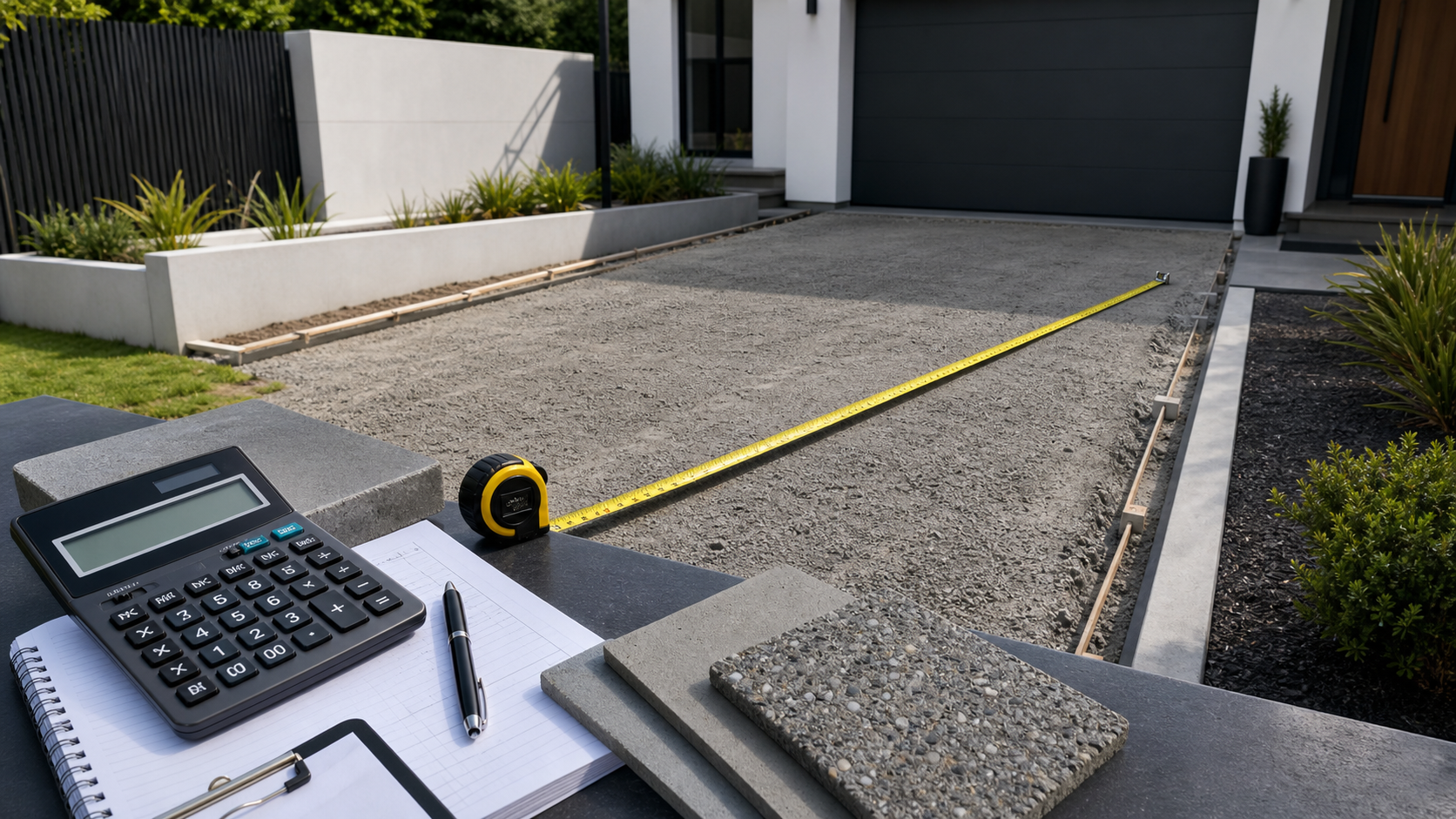
Three things worth doing before you ring anyone. Measure the drive in m² so every quote you receive is comparable. Decide bound or loose first, because they are different trades and you will get better pricing from a specialist in either. Then ask each quote for the slab thickness in mm, the steel mesh spec, whether excavation and spoil removal are included, and whether the total is plus or including GST.
We handle driveway installation across the Auckland region, from plain broom finishes to exposed and coloured aggregate. For a free on-site quote, call 09 977 9966 or email [email protected].
Ready to start your Auckland concrete project?
Contact Auckland Concrete Driveways for a free on-site quote. We cover central Auckland, North Shore, West Auckland, and South Auckland.