Costs & Pricing

New Concrete Driveway Cost: How to Read Your Auckland Quote Line by Line

Concrete driveway design finishes Auckland

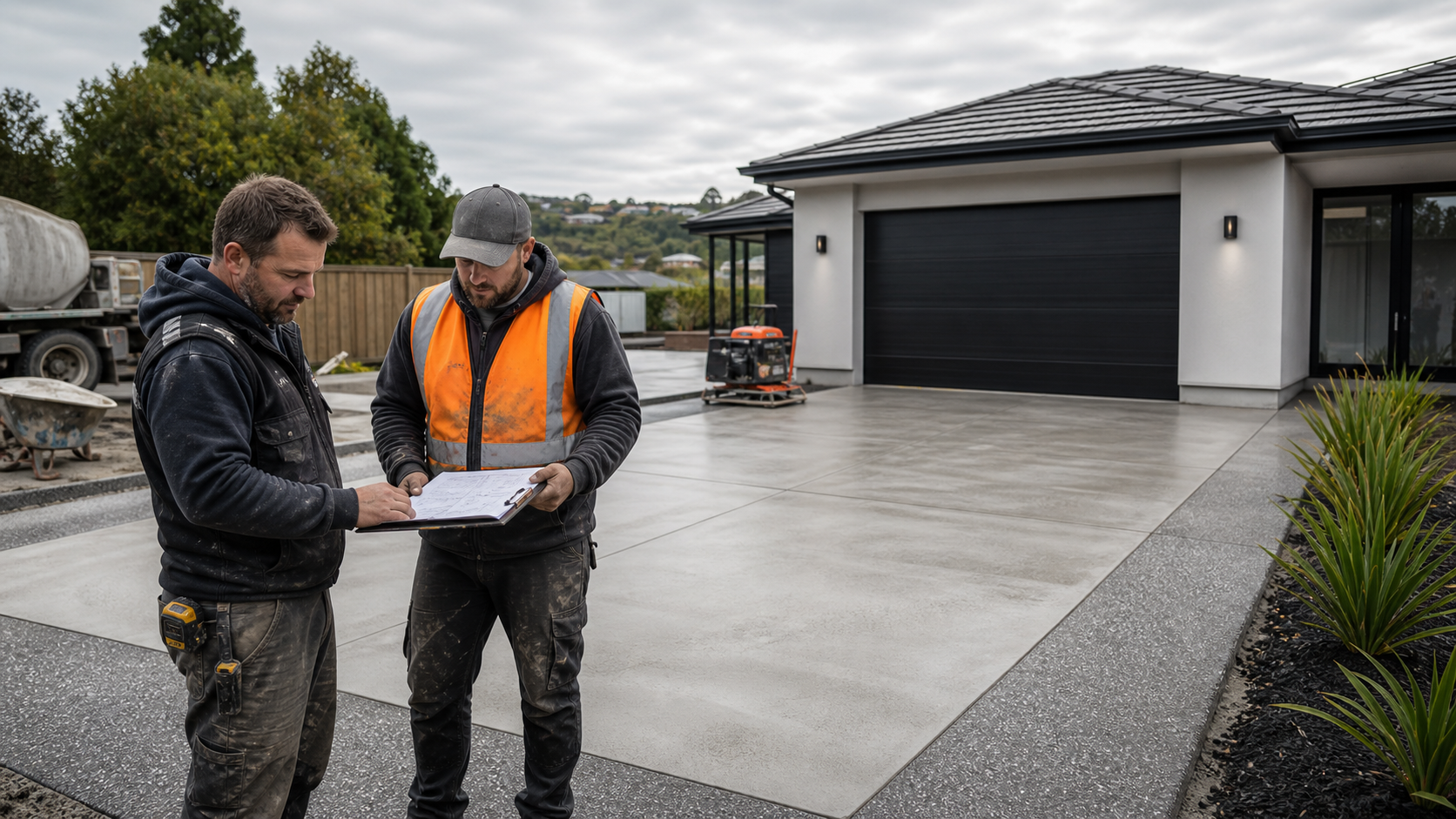
The rate per square metre on a driveway quote is the output, not the input. It falls out at the end, after someone has decided how deep to dig, what goes in the base, what mesh to lay, and whether anyone is coming back with a saw. That is why two quotes for the same driveway sit thousands apart and both look reasonable.

For context, new concrete driveway costs in Auckland generally land around $90 to $160 per m² for a plain finish. Those are indicative ranges from a September 2026 market survey, quoted before GST. No range replaces a number written after someone has stood on your site.

This article is not about the totals. How much it costs to concrete a driveway covers those by size.

If you want the reasons behind the variation, the factors that move driveway pricing covers them separately. This article is about the document in front of you: every line it should contain, what each line should specify, and what has quietly been left out of the cheap one.

What a complete concrete driveway quote should contain

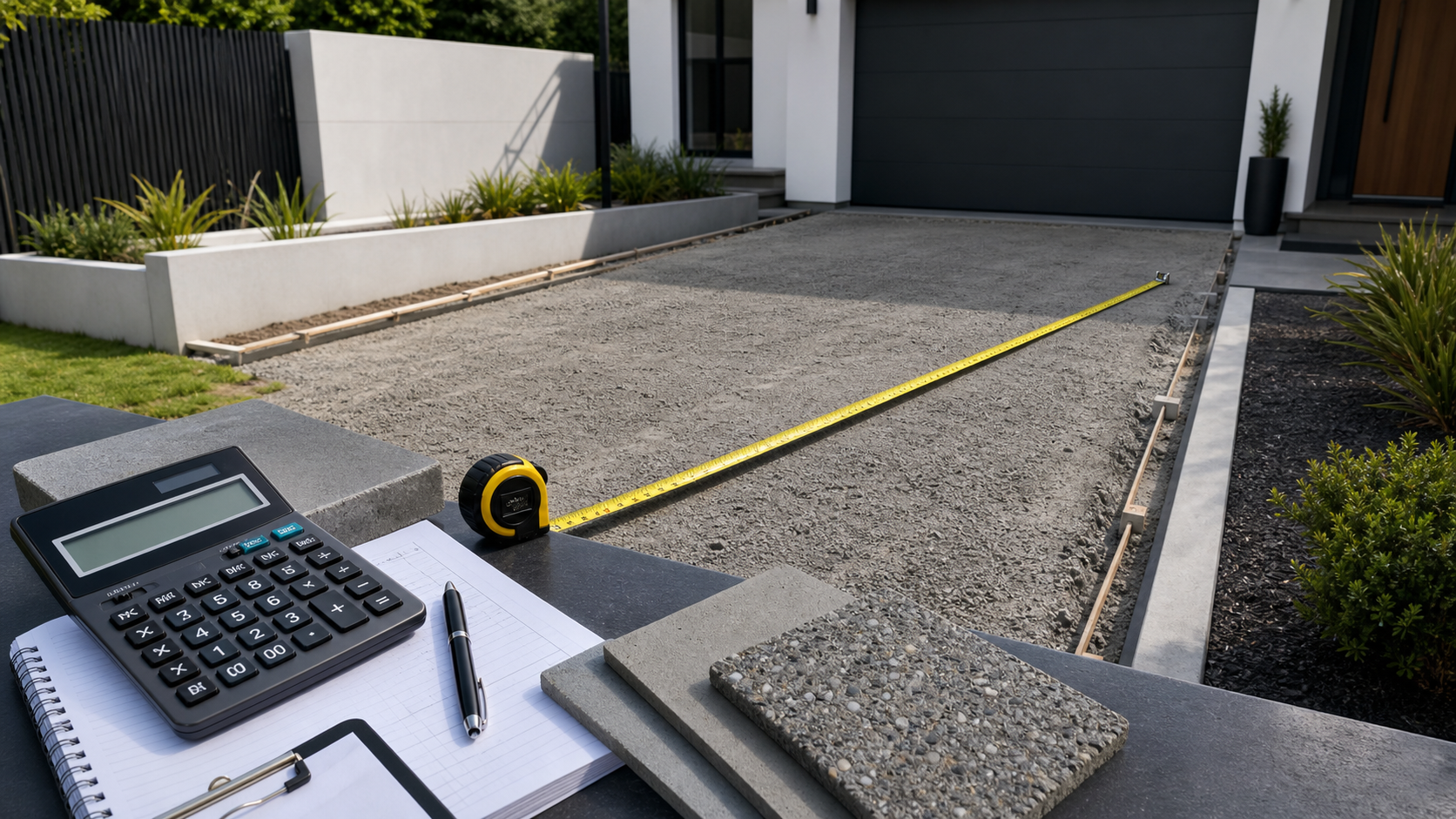
A proper quote for a new driveway has fourteen lines in it, and they run in the order the work happens.

StageLines
GroundworksSite setup and establishment · Excavation · Spoil removal · Hardfill and basecourse
PreparationSteel mesh and reinforcement · Boxing, levels and falls
The pourConcrete supply and slab thickness · Pumping and access · Placing, compaction and finishing
After the pourControl joint cutting · Curing and protection
Outside the slabThe vehicle crossing · Drainage · GST

Two documents decide what "good" looks like on those lines. The NZ Master Concrete Placers Association Code of Practice for Concrete Placement of Domestic Driveways sets what the slab itself has to achieve, down to base depth, mesh grade and cure time. Auckland Transport and Auckland Council govern the approvals, and they govern different parts of them.

A quote that names none of these specifications is not necessarily dishonest. It is unverifiable, which is a different problem and the one that costs you money.

Stage one: groundworks

This is where the money comes out of a cheap quote, because once the slab is on top nobody can see what is underneath it.

Site setup and establishment

Getting plant onto the property, protecting the access, silt control, setting out the job. On a flat Ponsonby frontage it is minor. On a steep Titirangi section with a narrow shared drive it is not, and it should be visible rather than absorbed into a rate.

Ask: is establishment a separate line or built into the square metre rate, and what does it cover?

Excavation and existing surface removal

Clause 1.2 of the placers' code requires soils, vegetation and weak material to be stripped out rather than built over. Your dig depth is slab thickness plus base depth, so a thicker slab means a deeper excavation, not simply more concrete. Breaking out an existing driveway is separate work again.

Ask: what depth are you excavating to, and is breaking out the old driveway in this price?

Spoil removal

Cubic metres out, truck movements, tip fees. Auckland clay is heavy, and clay that has sat through a wet winter is heavier again. A quote that says "remove spoil" without a volume is guessing, and the guess will be corrected in your favour or theirs later.

Ask: roughly how many cubic metres of spoil, and are cartage and tip fees included?

Hardfill and basecourse

The most important hidden line in the document. The placers' code calls for the excavated material to be replaced with 100 mm of Gap 20 or similar, placed and consolidated. Auckland clay, soft spots and old fill sites often need more than that, which is a decision made standing on the site rather than reading a plan.

Ask: what depth of basecourse, what material grade, and how is it compacted?

What a thin quote saysWhat it should say
"Prepare base""Excavate to 200 mm, supply and compact 100 mm Gap 20 basecourse"
"Remove spoil""Cart and dispose of approx. X m³ of spoil, tip fees included"
"Site prep"Itemised establishment, silt control and set-out

Stage two: preparation before the pour

Two lines decide how the finished slab behaves over its life, and both are settled before a truck arrives on site.

Steel mesh and reinforcement

Your quote should name a mesh grade. The placers' code specifies 665 or 668 mesh, with sheets overlapped and tied, internal corners reinforced, and specifically without cutting every second bar. Position matters as much as grade: the mesh sits in the top third of the finished slab, held there on chairs sized to the slab thickness.

Here is the part most homeowners have backwards. Steel mesh does not increase the load capacity of a driveway. It is crack control. It decides how a slab behaves once it cracks, not whether it can carry your vehicle. Load capacity comes from thickness and from what is under the slab.

As typical trade practice rather than a code requirement, F62 mesh is commonly paired with a 100 mm slab, F72 with 125 mm and F82 with 150 mm. Polypropylene or cellulose fibre is worth considering as well, for controlling plastic cracking in the first hours. Polythene under the slab is a minor line on a straightforward external driveway; it matters where moisture or bond-breaking is in play, and its absence is not a scandal.

Ask: what mesh grade, and where in the slab does it sit?

Boxing, levels and falls

Boxing sets the shape of the finished slab and decides where water goes, before any concrete arrives. The code sets a minimum fall of 1:100, which is 10 mm per metre, and a surface tolerance of ±10 mm from the established datum, string lined in several directions. Hand-tooled joints are marked out on the formwork before the pour is confirmed, which means the jointing plan exists before the truck turns up rather than being improvised afterwards.

Ask: what fall are you setting, and which way does the water run?

For a free on-site quote anywhere in Auckland, call 09 977 9966.

Stage three: the pour

This is the only stage most homeowners picture, and it is the one where the biggest numbers sit. It is also where the specifications are easiest to check.

Concrete supply and slab thickness

Your quote should name a strength. The placers' code sets 20 MPa or stronger as the minimum for a domestic driveway, and a minimum slab thickness of 100 mm. It also requires the slab to reflect its actual use: trucks and heavy vehicles need a designed slab for the additional loading, which in practice puts campervans, boats and trailers into 125–150 mm territory.

Thickness drives volume and volume drives the supply line, so the two belong together on the page. Concrete supply sat around $160 to $250 per m³ across 2025, and roughly $200 to $300 per m³ including a contractor to place it, again as indicative September 2026 ranges before GST that a site visit should confirm. Concrete costs per cubic metre covers that side in detail.

One specification worth knowing about: NZS 3104:2003 limits water added on site to 10 litres per m³. Adding water at the truck makes concrete easier to place and weaker once it sets, which is why the mix and the slump belong in writing.

Ask: what strength is the mix, what slump, and what thickness is the volume based on?

Pumping and access

Whether the truck can reach the pour changes the price materially. The code notes that larger pumps able to handle 19 mm stone produce less shrinkage and fewer cracks than pumps restricted to smaller aggregate, so the pump choice is not purely a logistics question.

There is no reliable published rate for concrete pump hire in Auckland. Any article quoting you one is guessing. It is a site-specific line and it should appear on your quote as its own line rather than as a surprise on pour day.

Ask: can the truck reach the pour, and if not, who carries the pump cost?

Placing, compaction and finishing

The placers' code is unambiguous on compaction: all concrete must be vibrated, whether by immersion vibrator, vibrating screed, or a float with a mini-vibrator. Concrete that has not been properly compacted has voids in it, and voids are where failure starts.

Finish is governed by NZS 3114:1987. Worth knowing before you choose: a hard trowelled finish is smooth and genuinely slippery outdoors, which is why broom and sponge finishes exist. Decorative concrete driveway options sit at a different rate again, typically $150 to $250 per m² for exposed aggregate, coloured or stamped work as an indicative Auckland range before GST that a site visit should confirm, with stone choice and sealing moving it either way. Exposed aggregate driveways covers those finishes properly.

Ask: how is the concrete compacted, and exactly what finish am I getting?
Stage four: after the pour

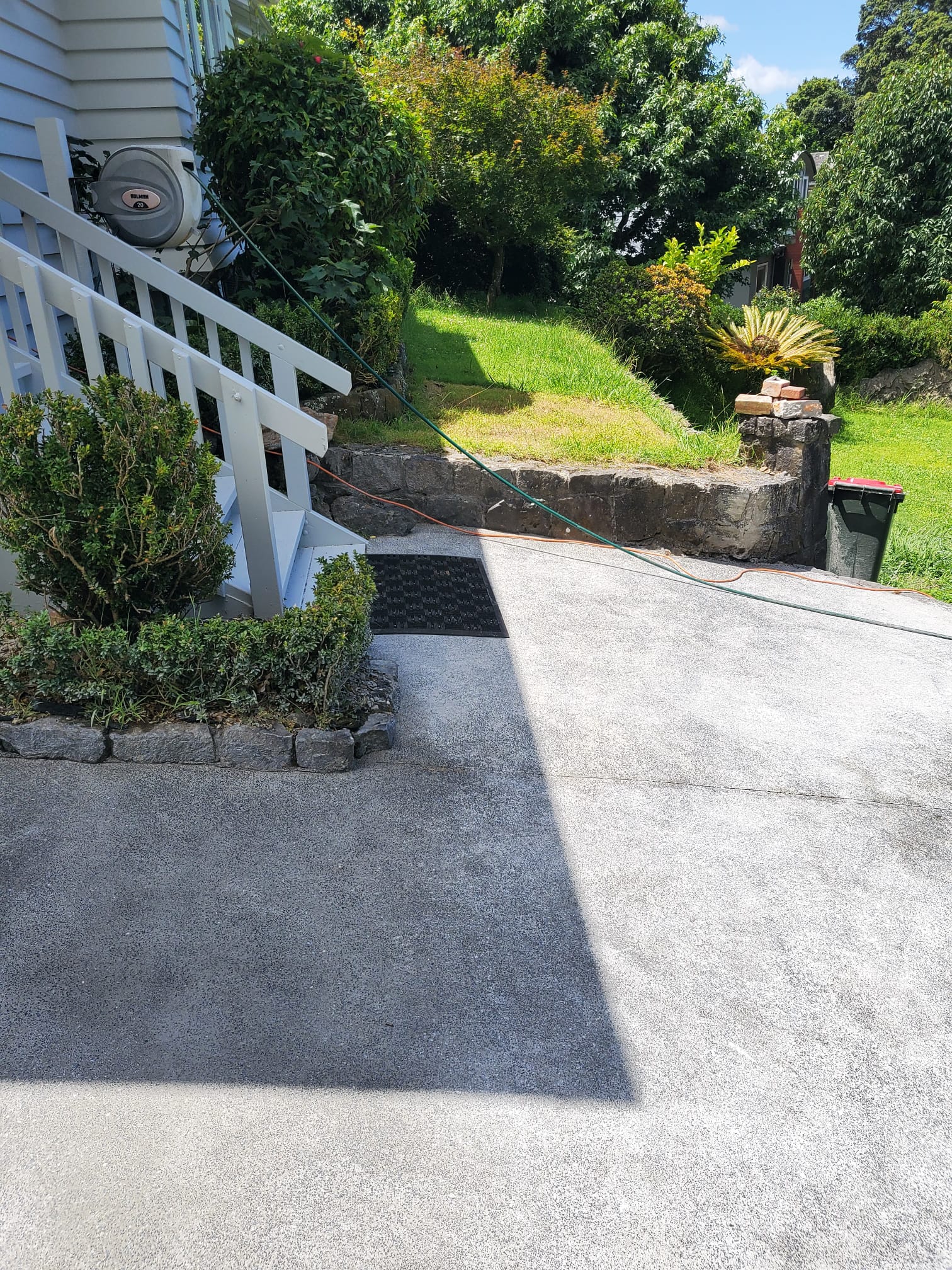
These are the two lines a cheap quote deletes silently, and they are the two most likely causes of the cracking you are worried about.

Control joints and cutting

The code calls for control joints to be cut 24 to 48 hours after placing, at 3 m centres, to a depth of a quarter of the slab thickness. On a 100 mm slab that is a 25 mm cut.

What the joint does is simple. Concrete shrinks as it cures and it will crack somewhere. A cut joint decides where. No cutting plan means the slab picks its own line, usually diagonally across the middle of your new driveway. A quote with no jointing line is the clearest single sign of corners being cut.

Ask: when are joints cut, at what spacing, and to what depth?

Curing and protection

The code calls for constant water curing for a minimum of four days (96 hours), or another recommended curing method, and for pets and people to be kept off for the first 12 to 24 hours.

The practical problem is that curing is labour happening after the crew would otherwise have packed up, which makes it easy to drop from a price. Whether the contractor cures the slab or hands you a hose and an instruction is a real difference in both cost and outcome. Either arrangement is fine. Not writing it down is not.

Ask: what curing method, for how long, and whose job is it?

Stage five: the lines that sit outside the slab

Three items sit outside the slab itself, and all three are regular sources of disputed invoices.

The vehicle crossing

The vehicle crossing is the strip between your property boundary and the road. It is the largest single exclusion in cheap Auckland quotes, and homeowners rarely notice because it looks like part of the driveway.

Get the approvals straight, because most pricing pages do not:

BodyWhat it does
Auckland TransportIssues the Vehicle Crossing Permit, assesses the Engineering Approval, and handles encroachment approval, Corridor Access Requests and Temporary Traffic Management Plans
Auckland CouncilAdministers the Auckland Unitary Plan, and grants Resource Consent, Building Consent and the Engineering Approval itself

Written approval from Auckland Transport is required before work starts on building, modifying or repairing a crossing, and AT assesses applications against Chapter E27 of the Auckland Unitary Plan.

The geometry drives the price. Under AT's vehicle crossing standards, the standard crossing width at the kerbline is your rear width plus 1400 mm with 900 mm side splays. A shared crossing is mandatory where adjacent driveways sit less than 4.2 m apart at the property boundary. The footpath has to stay 1.8 m wide through a shared crossing, and a residential waiting platform of 4 m at no more than 5% gradient is required clear of the footpath. Any of those can turn a simple job into a redesign.

There is no reliable published price range for crossing works, because kerb removal, drainage, traffic management and AT's requirements vary too widely to average. It has to be quoted on your actual frontage. Driveway rules and vehicle crossing approval covers the process itself.

Ask: is the crossing in this price, who lodges the AT application, and who carries the cost if AT requires a redesign?

Drainage and stormwater

Falls, channel drains, and where the water actually ends up. Auckland rainfall and clay soils make this a real line rather than a nicety, and impervious surface rules under the Unitary Plan can affect what you are allowed to seal over. West Auckland council requirements for driveways covers the consent side.

Ask: where does the water go, and is any drainage work in this price?

GST

Trade quotes are usually written plus GST. Consumer-facing quotes are usually GST-inclusive. A quote that does not say which is offering you a 15% saving that does not exist, and it is the cheapest gap in the industry to close.

Ask: is this number plus GST or including GST?

Red flags in a suspiciously cheap quote

A cheap quote is usually cheap for a reason that is written down, or rather for a reason that is not.

Red flagWhat it saves the contractorWhat it costs you
No base depth or material statedLess hardfill, less compaction timeSettlement and cracking once the base moves
No mesh grade or positionLighter mesh, or mesh laid flat on the baseCrack control that is not where it needs to be
No slab thicknessConcrete volumeA slab not rated for what you park on it
No joint cutting planA return visit with a sawThe slab chooses its own crack lines
No curing methodDays of labour after the pourSurface strength and durability
Vehicle crossing excluded or unmentionedAn entire scope of workA separate bill, and an AT approval you now own
GST basis unclearNothing, but the number looks 15% smallerA 15% surprise at invoice time

There are process signals too. A price texted through without a site visit is not a quote, it is a guess with a number attached. Neither is a single total with no scope behind it, because it gives you nothing to hold anyone to. Pressure to sign quickly and an unwillingness to show proof of public liability cover are the other two worth walking away from.

The one-page quote audit

Put your quotes side by side and work down this table.

Line itemWhat good looks likeThe question to ask
Site setupItemised, not absorbed into the rateIs establishment separate, and what does it cover?
ExcavationDepth stated, weak material removedWhat depth are you digging to?
Spoil removalVolume, cartage and tip fees statedHow many m³, and are tip fees in?
Basecourse100 mm Gap 20 minimum, placed and consolidatedWhat depth, what grade, compacted how?
Steel mesh665 or 668, top third of the slab, on chairsWhat grade, and where does it sit?
Boxing and fallsMinimum 1:100 fall, ±10 mm toleranceWhat fall, and which way does water run?
Concrete supply20 MPa or stronger, slump statedWhat strength and slump?
Slab thickness100 mm minimum, designed slab for heavy vehiclesIs it rated for what I park on it?
PumpingNamed as its own line if access is tightCan the truck reach, and who pays for the pump?
Placing and finishingVibrated, finish namedHow is it compacted, what finish?
Joint cutting3 m centres, quarter depth, cut at 24–48 hoursWhen, what spacing, what depth?
CuringMinimum 96 hours, method namedWhat method, how long, whose job?
Vehicle crossingIn or out, stated plainly, AT application allocatedWho lodges it, who pays for a redesign?
DrainageFalls and any drainage work itemisedWhere does the water go?
GSTBasis stated on the documentPlus GST or including GST?

What an honest contractor will tell you

The placers' code is unusually candid, and the parts worth repeating are the parts nobody enjoys hearing.

Concrete can crack. It is not possible to guarantee the absence of cracking, regardless of the process or placing system used. Colour consistency, surface texture and flatness will vary across a slab, and those variances are explicitly not grounds for rejection. Colour swatches and samples are indicative only. Steel mesh controls cracking rather than carrying load.

Auckland adds its own conditions on top. Clay soils move seasonally, rainfall is high, and a good number of sections on the North Shore and out through Titirangi are steep enough that the slab, the falls and the crossing all have to be designed around the grade rather than assumed.

A contractor who tells you none of this is either inexperienced or telling you what you want to hear. For anyone wanting to read further, CCANZ Information Bulletin IB80 covers residential concrete driveways and paths in detail.

Frequently asked questions

What should be included in a concrete driveway quote?

Site setup, excavation, spoil removal, hardfill and basecourse, steel mesh, boxing and falls, concrete supply, slab thickness, pumping if access is tight, placing and finishing, control joint cutting, curing, the vehicle crossing, drainage, and a stated GST basis. Missing lines are the usual reason two quotes differ.

How thick should a residential concrete driveway be in New Zealand?

The NZ Master Concrete Placers Association code sets a minimum of 100 mm for a domestic driveway, and requires the slab to reflect its actual use. Heavier vehicles such as campervans, boats and trailers need a designed slab for the additional loading, which usually means 125 mm to 150 mm.

What concrete strength is required for a driveway in NZ?

The placers' code specifies 20 MPa or stronger for a domestic driveway. Your quote should name the strength and the slump. NZS 3104:2003 also limits water added on site to 10 litres per m³, because water added at the truck makes concrete easier to place and weaker once it has set.

Who approves a vehicle crossing in Auckland?

Auckland Transport issues the Vehicle Crossing Permit and assesses the Engineering Approval. Auckland Council administers the Auckland Unitary Plan and grants Resource Consent, Building Consent and the Engineering Approval itself. They are separate processes, and written AT approval is required before any work starts on the crossing.

Is the vehicle crossing included in a concrete driveway quote?

Often not, and it is the largest exclusion in cheap quotes. Crossing works have no reliable published price range because kerb removal, drainage, traffic management and AT requirements vary so widely. Ask directly whether it is in or out, and who is lodging the AT application.

Do concrete driveway prices include GST?

It depends entirely on who wrote the quote. Trade quotes are usually plus GST, consumer quotes are usually GST-inclusive, and plenty of documents never say. A 15% difference is worth one question, so ask which basis the number is on before you compare two quotes against each other.

When should control joints be cut in a new driveway?

The placers' code calls for control joints to be cut 24 to 48 hours after placing, at 3 m centres, to a depth of a quarter of the slab thickness. Concrete shrinks and will crack somewhere; a cut joint decides where. A quote with no jointing line is a clear warning sign.

What to do next

Print the audit table and run both quotes down it. Send the missing-line questions in writing rather than raising them on the phone, so you have the answers on paper alongside the price. If a contractor will not put a base depth, a mesh grade, a slab thickness or a curing method in writing, that refusal is your answer, and it is a cheaper one to receive now than in five years.

For a free on-site quote anywhere in Auckland, call 09 977 9966 or email [email protected].

Ready to start your Auckland concrete project?

Contact Auckland Concrete Driveways for a free on-site quote. We cover central Auckland, North Shore, West Auckland, and South Auckland.