This is the part most cost guides skip, and it is the reason two quotes for the same area can differ by thousands. Concrete is priced by what it has to do, and what it has to do sets the thickness, the mesh and the base underneath.
The NZ Master Concrete Placers Association Code of Practice for Concrete Placement of Domestic Driveways sets the baseline that a competent Auckland contractor works to:
- Slab thickness of 100 mm minimum, and thickness must reflect the use. Trucks and heavy vehicles need a designed slab for the additional loading (cl. 2.1)
- Concrete strength of 20 MPa or stronger (cl. 2.2)
- 100 mm of Gap 20 or similar, placed and consolidated, once soils, vegetation and weak material have been dug out (cl. 1.2)
- Fall of 1:100 minimum, which is 10 mm per metre (cl. 2.2, 3.3)
- 665 or 668 steel mesh, sheets overlapped and tied, sitting in the top third of the finished slab on chairs that suit the thickness (cl. 5.1–5.3)
- Control joints cut 24–48 hours after placing, at 3 m centres, to a quarter of the slab depth (cl. 5.1–5.2)
- Water curing for a minimum of four days (cl. 4.3)
Each of those items has a cost. A quote that skips the base depth or the mesh spec is not cheaper, it is just less complete.
Thickness by use
| Use | Typical thickness | Typical reinforcement |
|---|
| Garden path, pedestrian only | 75–100 mm | Light-duty mesh, or fibre |
| Patio | 100 mm | Mesh |
| Standard residential driveway, cars only | 100 mm | 665 or 668 mesh in the top third |
| Driveway carrying a boat, trailer or campervan | 125–150 mm | Heavier mesh; F72 and F82 are typical trade practice at those thicknesses |
| Garage or shed floor | 100–150 mm | Mesh, with 150 mm where heavier equipment gets stored |
| House slab or foundation | Per the engineer's design | Per the engineer's design |
The 100 mm minimum in the code applies to domestic driveways. Pedestrian-only paths are commonly laid thinner, which is why a path prices below a driveway even though the concrete in the truck is identical.
That difference should be itemised. If you are parking a campervan on a slab specified at 100 mm, you are buying a driveway that will not last, and the saving disappears the first winter it cracks.
Does it need steel mesh?
Yes, and it is worth understanding what the mesh is actually for. Steel mesh does not increase the load capacity of a slab. It provides crack control. Thickness and the compacted base carry the load.
The code itself is refreshingly blunt about the limits of the material:
> "Concrete can crack. It is not possible to guarantee the absence of concrete cracking, regardless of processes and placing systems employed."
Colour, surface texture and flatness will vary across a pour, and the code states that these variances are not grounds for rejection. Colour swatches and samples are indicative only. Anyone promising a perfectly uniform, crack-free slab is promising something the standards body will not.
One more finish note worth knowing before you choose. Hard trowelling produces a smooth surface that is slippery outdoors in Auckland rain, which is why broom and sponge finishes exist for driveways, patios and paths.
The base under the slab
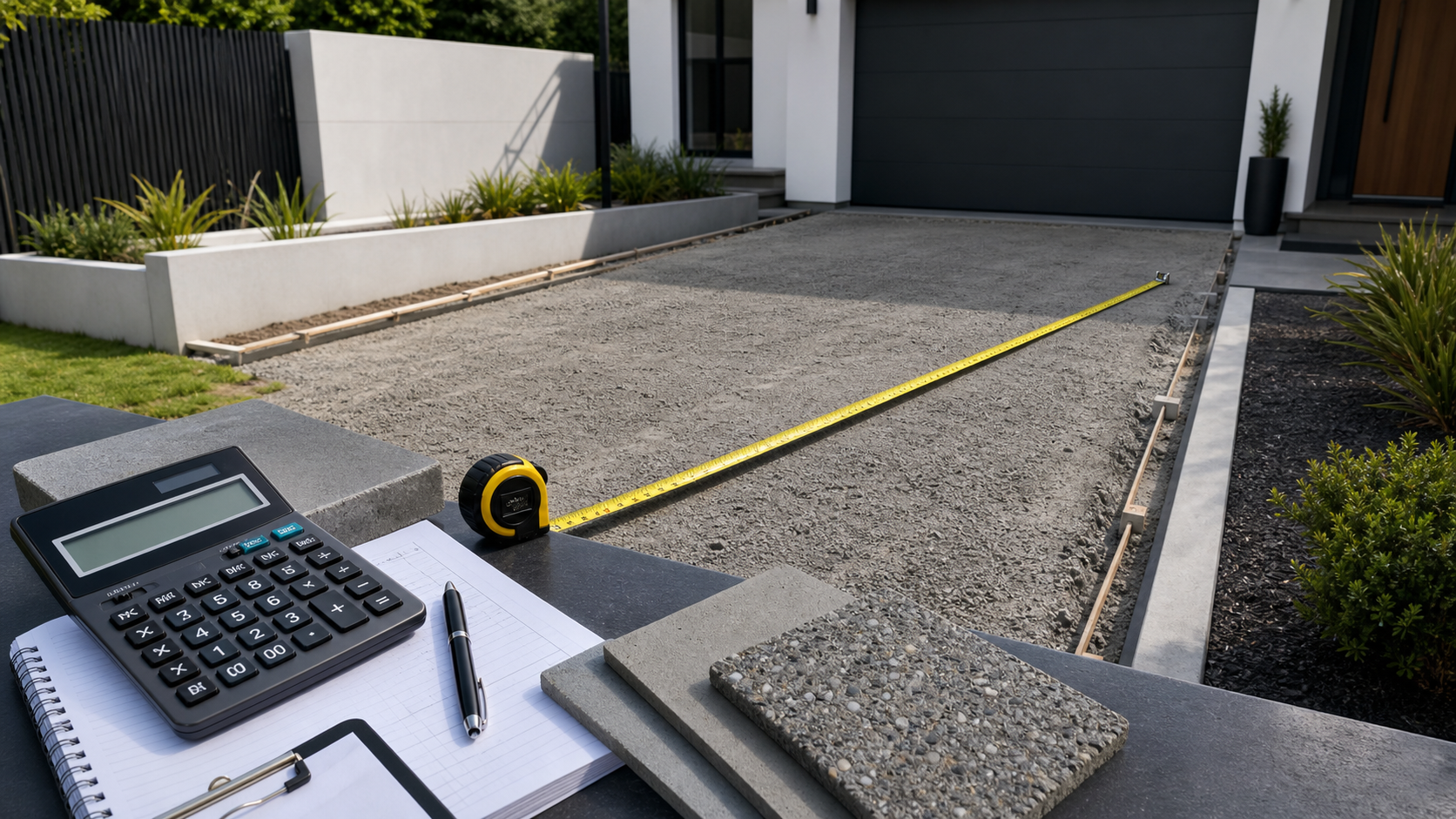
The groundwork is where the money goes and where failures start. Weak material comes out, 100 mm of compacted Gap 20 goes in, and the finished surface should sit within ±10 mm of the established datum, string lined in several directions.
The code is emphatic that all concrete must be vibrated, whether by immersion vibrator, vibrating screed or a float with a mini-vibrator. Poorly compacted concrete looks the same on day one and behaves differently in year three.
A quote that does not state a base depth cannot be compared to one that does. That single line is often the whole difference between two prices.